Most Florida homeowners have heard of eminent domain — the process where a government agency files a lawsuit to acquire part of your property for a public project. Far fewer have heard of its quieter counterpart: inverse condemnation.
Inverse condemnation is what happens when the government damages, floods, or effectively takes part of your property without ever filing a formal case — and leaves you to seek compensation on your own.
This article explains what an inverse condemnation claim looks like in Florida, the common fact patterns that trigger it, and why acting early can make a real difference in the outcome.
What Inverse Condemnation Actually Means
Under the Florida Constitution and the Fifth Amendment, private property cannot be taken for public use without just compensation. In a traditional eminent domain case, the condemning authority — such as FDOT, a county, a city, or a utility — comes to you and files a petition. The property owner is the defendant, and the process is designed around a formal taking.
Inverse condemnation flips that around. The property owner is the one who has to come forward and sue, because the government has already interfered with the property but has not formally acquired it. The core legal question is the same: has there been a taking of private property for public use that requires just compensation?
Common Fact Patterns in North Florida
Inverse condemnation claims arise from a wide range of situations. Some of the most common ones we see affecting homeowners in Jacksonville and the surrounding counties include:
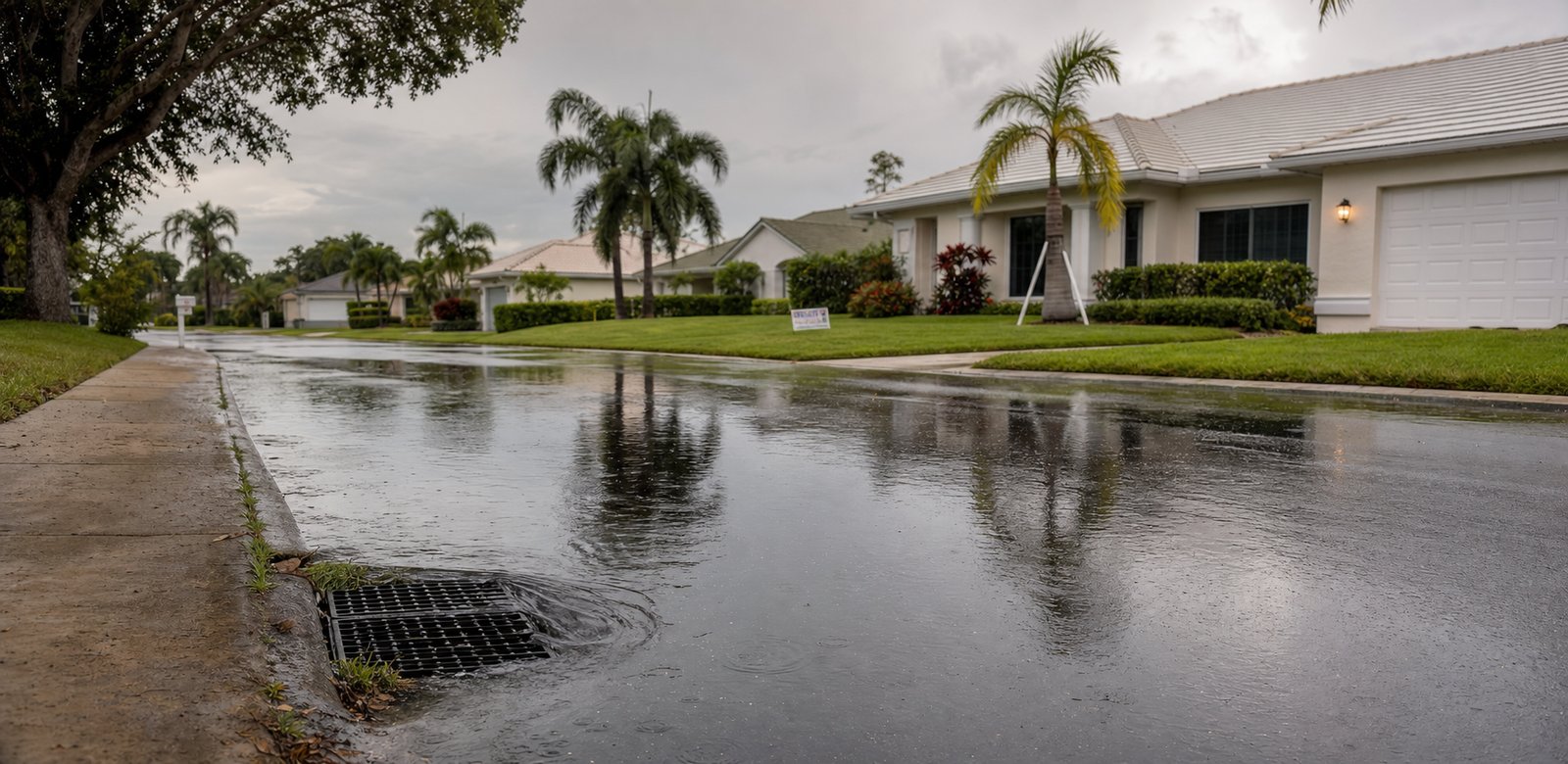
- Flooding from public drainage systems. A newly built road, retention pond, ditch, or stormwater outfall repeatedly pushes water onto private land that used to drain normally.
- Road grade changes. A resurfacing, widening, or intersection project raises or lowers the roadway so that the property no longer drains, or is now well below street level.
- Loss of access. A median, curb cut change, or new limited-access design cuts off a driveway or leaves a commercial property with only a difficult back entrance.
- Physical intrusion. A pipe, drainage swale, fence, or utility component ends up placed on private land outside any recorded easement.
- Construction damage that is not repaired. Public project work causes cracking, settlement, tree loss, or destruction of improvements, and the responsible agency refuses to make the owner whole.
In each of these situations, the government has done something — or allowed something — that materially affects the property, but has not offered to acquire the affected rights and pay for them up front.
Physical Takings vs. Regulatory Takings
Florida courts generally analyze inverse condemnation claims in two broad categories:
- Physical or "de facto" takings. The government physically occupies, invades, or floods your land, or destroys something on it. Repeated flooding from a public drainage system is a classic example.
- Regulatory takings. A law, ordinance, or permitting decision restricts the use of your property so severely that its value or reasonable use is substantially eliminated.
Regulatory takings claims in Florida often overlap with the Bert J. Harris, Jr., Private Property Rights Protection Act, which provides its own separate remedy when a new regulation "inordinately burdens" an existing use or vested right in real property. The right pathway depends on the specific facts, timing, and notices involved.
What "Just Compensation" Can Include
When an inverse condemnation claim succeeds, the compensation analysis is similar to a formal eminent domain case. Depending on the facts, it may include:
- The value of the property or property right actually taken — for example, a permanent drainage easement that now exists in fact.
- Severance damages to the remaining property, when the taking or interference has reduced the value or usefulness of what is left.
- Costs to cure, such as regrading, drainage improvements, or restored access, when those costs are reasonable and supported by the evidence.
- Business damages, in specific commercial cases meeting Florida statutory requirements.
- Attorney's fees and expert costs in appropriate cases, consistent with Florida law.
The exact scope depends on the type of taking, the property, and the proof presented. Careful documentation of the "before" and "after" conditions is often the difference between a strong claim and a weak one.
Why Timing Matters
Inverse condemnation claims are subject to statutes of limitations and other timing rules under Florida law. Because these claims often develop gradually — flooding gets worse each season, cracks widen, access complaints go unanswered — it can be tempting to wait and see whether the problem resolves itself.
Waiting too long can create real problems:
- Time-based deadlines may bar the claim entirely.
- Photos, video, and neighbor recollections lose detail and reliability.
- The condition of the property changes, making the "before" harder to reconstruct.
- Agencies may make additional changes that complicate the analysis.
Even if you are not ready to file suit, it is usually worth documenting the condition and speaking with counsel as soon as you suspect the government's action is causing lasting harm.
What Homeowners Can Do Now
If you believe a public project, drainage system, or regulation is damaging your property, a few practical steps can strengthen a potential claim:
- Document everything with dates. Take photos and video during and after each rain event, construction phase, or notable change. Save the metadata.
- Keep a written log. Note when flooding, cracking, access problems, or other issues occur, how long they last, and what you observed.
- Gather older records. Prior surveys, elevation certificates, insurance photos, and appraisals help establish the property's condition before the government's action.
- Preserve every notice and letter. Save mailings, emails, permit notices, and any responses from agencies or contractors.
- Report the issue in writing. Written complaints to the responsible agency create a record and sometimes trigger internal review.
These are the kinds of records that engineers, appraisers, and attorneys rely on to reconstruct exactly what happened and why the government should pay for it.
How a Property Rights Attorney Can Help
Inverse condemnation cases are fact-intensive and often technical. A Florida property rights attorney can help by:
- Evaluating whether the facts fit an inverse condemnation, Bert Harris, negligence, or other theory.
- Identifying the correct government entity or utility to pursue.
- Working with engineers, hydrologists, surveyors, and appraisers to build the evidence.
- Handling pre-suit notices and negotiations before litigation becomes necessary.
- Filing and pursuing the claim in the proper court if a fair resolution is not offered.
Many homeowners who ultimately have strong claims never pursue them because the process feels overwhelming and the responsible agency is unresponsive. Early legal advice can help you understand whether a claim is realistic before you invest significant time and expense.
Serving Homeowners Across Jacksonville and North Florida
Loper Law Group, P.A. is a Florida law firm focused on property rights, eminent domain, and inverse condemnation matters, including drainage, access, and construction-related takings affecting homeowners in Jacksonville and throughout North Florida. The firm's goal is to help property owners understand whether they may have a claim, what evidence supports it, and what options they have going forward.
If you believe a public project, drainage system, or regulation has damaged your property or effectively taken part of it, consider getting the situation reviewed before deadlines pass or the site condition changes.